
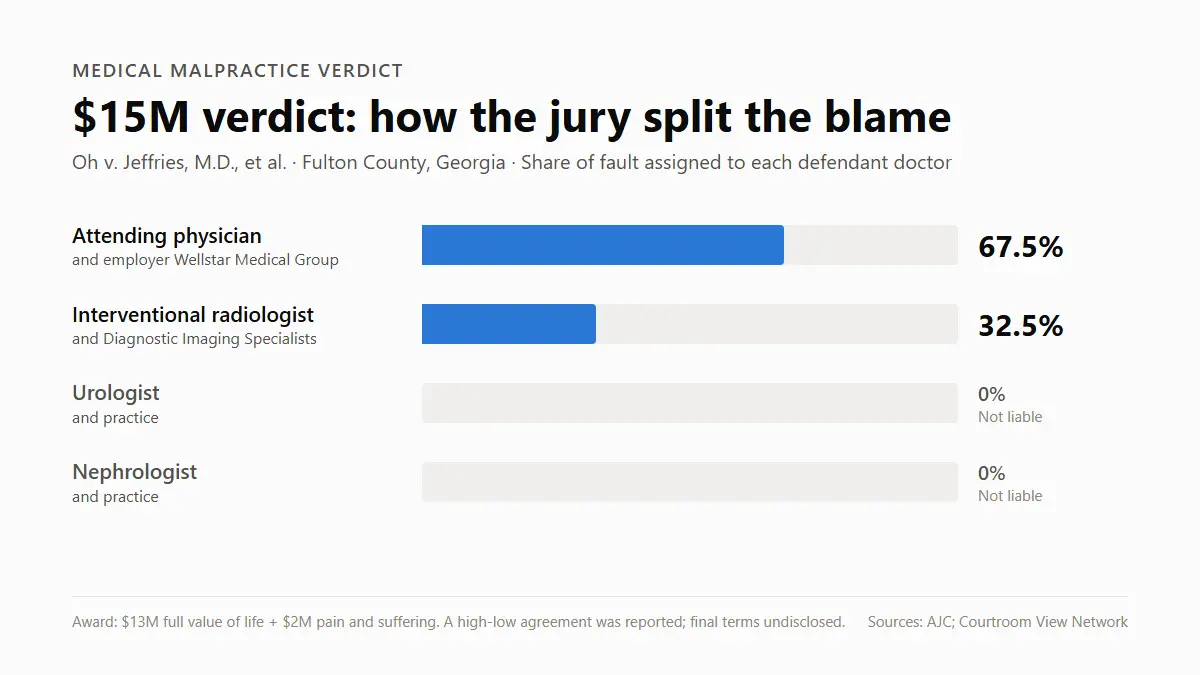
A Fulton County jury awarded $15 million to the family of a retired U.S. Army veteran who died from post-surgery complications, finding that two of his doctors caused his death. The case is Oh v. Jeffries, M.D., et al., 20EV002508. Four physicians defended themselves at trial. The jury found two of them liable and cleared the other two, so the case is a useful look at how a jury divides responsibility when many clinicians share one patient.
The patient and his care
Byung “Ben” Oh fell from a ladder while working in his yard on April 30, 2018, fracturing a bone in his back. He was admitted to WellStar’s Atlanta Medical Center and underwent spine surgery on May 4. During recovery over the following weeks, he showed abdominal distension and decreased urine output. A urologist relied on bladder scans in diagnosing a urinary obstruction and ordering catheterization, and interventional radiologist Barry Jeffries, MD, placed a suprapubic catheter.
After the procedure, roughly 87 liters of milky, whitish fluid, later found to include chyle, drained from Mr. Oh over 11 days. That is about 23 gallons. The catheter had been placed outside the bladder. Mr. Oh died July 21, 2018, from septic shock and organ failure. In a pretrial filing, his family said he was aware of his suffering, wrote notes of despair to relatives who stayed with him daily, and gradually wasted away from nutrient and fluid loss.
What the family alleged
The family’s central claim was that no one took charge. They said none of the doctors took ownership of his deteriorating condition or meaningfully communicated with each other to resolve it.
Against attending physician Amy Wyrzykowski, MD, the plaintiffs alleged she failed to coordinate care among specialists, did not personally review critical imaging, and dismissed the significance of the fluid leak. Their attorney, Lloyd Bell, also argued that she failed to follow up on a finding of abnormal fluid in Mr. Oh’s abdomen well before the catheter procedure.
Against Dr. Jeffries, the family said he botched the catheter placement and also failed to adequately investigate the fluid leak. The original complaint said contrast imaging was either not performed or not recorded, and that the two recorded X-rays could not confirm where the catheter sat. A later contrast CT of the pelvis reportedly showed the catheter above the bladder. Bell told jurors that the abnormal color of the half-liter of fluid that drained right after the procedure should have prompted Dr. Jeffries and Dr. Wyrzykowski to check whether the catheter was in the right place.
What the defense argued
Each defendant denied wrongdoing and argued they provided reasonable care under the circumstances. At trial, Dr. Wyrzykowski’s attorney pointed to Mr. Oh’s other conditions, including pneumonia and kidney failure, and argued that the chyle leak was extraordinarily rare and that she investigated the fluid output within the standard of care while reasonably expecting the catheter was properly placed. He described it as a case built on hindsight.
Dr. Jeffries’ attorney, Dan Huff, made a similar argument. He said Dr. Jeffries relied on video imaging during the procedure and that immediate drainage led him to believe the catheter was correctly placed. In closing, Huff told jurors, “The question is not whether the catheter was misplaced. We know it was,” and argued that reasonable steps had been taken in placing it.
The urologist, Thomas Schoborg, MD, argued that the leak was an incredibly rare condition and that any delay in diagnosis came from the complexity of the case, not malpractice. His attorney also said a urologist was not the fluid-management expert on the team and was not expected to lead the search for the cause of the abnormal output. Counsel for nephrologist Khalid Iqbal, MD, stressed that he was called in specifically for Mr. Oh’s kidney disease and argued the leak was diagnosed within a reasonable time given everything affecting the patient.
Wellstar said its internal investigation found the care team followed appropriate protocols and correctly carried out the prescribed procedures, and it extended condolences to the family.
Medical background
A chyle leak occurs when damaged lymphatic vessels let chyle, a fluid containing fats, proteins, and infection-fighting white blood cells, escape into nearby tissue. Cleveland Clinic describes it as rare but serious, with risks of dehydration, poor nutrition, and infection. It is most often associated with head and neck surgery. Most leaks are managed with diet changes and medication, but heavy fluid loss can become life threatening.
Suprapubic catheter placement is a common image-guided procedure. One published report cites a study of 549 patients with a 99.6% technical success rate for primary tube placement. Clinical reference material notes that contrast can help visualize the bladder and that cystoscopic confirmation is recommended when feasible. These are general descriptions and not the legal standard of care in this case.
The verdict
The 10-day trial was bifurcated under Georgia law into liability and damages phases. It began July 21, the eighth anniversary of Mr. Oh’s death, and capped six years of litigation since the family filed suit in April 2020.
Jurors awarded $2 million for Mr. Oh’s conscious pain and suffering and $13 million for the full value of his life. They found Dr. Wyrzykowski and her employer, Wellstar Medical Group, 67.5% to blame, and apportioned the rest to Dr. Jeffries and his employer, Diagnostic Imaging Specialists. Dr. Iqbal and Dr. Schoborg, along with their practices, were cleared of any wrongdoing.
The split is the most interesting part of the outcome. The clearest procedural error was the misplaced catheter, yet the attending physician carried roughly twice the radiologist’s share. The jury did not explain its reasoning, but the plaintiffs’ case was built around coordination. After the verdict, Bell said the case came down to the care team repeatedly overlooking evidence that the catheter was draining lymphatic fluid rather than urine over 11 days. On the other side, Huff said he knew from talking to jurors that they struggled over finding fault for his clients.
How Georgia divides fault
Georgia’s apportionment statute, O.C.G.A. § 51-12-33, directs juries to assign percentages of fault. A 2022 amendment extended that framework to actions against one or more persons and eliminated joint liability and the right of contribution. Juries can also consider the fault of people or entities not named in the suit. In practice, each defendant generally answers only for its assigned share, which makes the percentage split a central fight in cases with several providers.
Georgia also places no cap on the pain and suffering portion of an award like this one. In 2005 the legislature enacted a $350,000 cap on noneconomic damages in malpractice cases, which the state Supreme Court struck down in the 2010 Nestlehutt decision. Defendants asked the court to revive the cap, but in June 2026 it issued decisions confirming that noneconomic damages in medical malpractice cases remain uncapped.
Where the case stands
The $15 million figure may not reflect what was actually paid. Huff told CVN that the award against his client fell within the range of a negotiated high-low settlement agreement. The terms were not disclosed. Bell told the AJC “The case has now been resolved to the family’s satisfaction,” and the urologist’s attorney said the judge made sure there were no errors to support an appeal, so all parties have finality. Public reporting through early October 2026 does not mention an appeal.
This post is general information and not legal advice.
Sources
Atlanta Journal-Constitution, “Fulton jurors award $15M to veteran’s family in medical malpractice trial” (Aug. 6, 2026)
Courtroom View Network, “Georgia Jury Awards $15M in Med Mal Trial Over Patient’s Death Following Lymphatic Fluid Leak” (Aug. 11, 2026)
Radiology Business, “$15M jury verdict after radiologist improperly places catheter, leading to patient death” (Aug. 14, 2026)
Bell Law Firm press release via PR Newswire (Aug. 13, 2026)
Phelps Dunbar, “Georgia Supreme Court Hears the Case for Medical Malpractice Damages Cap” (Mar. 2, 2026)
Cleveland Clinic, “Chyle Leak”
Thieme, percutaneous suprapubic cystostomy technique paper; StatPearls, “Suprapubic Bladder Catheterization”
Subrogation Strategist (White and Williams), Georgia apportionment statute summary